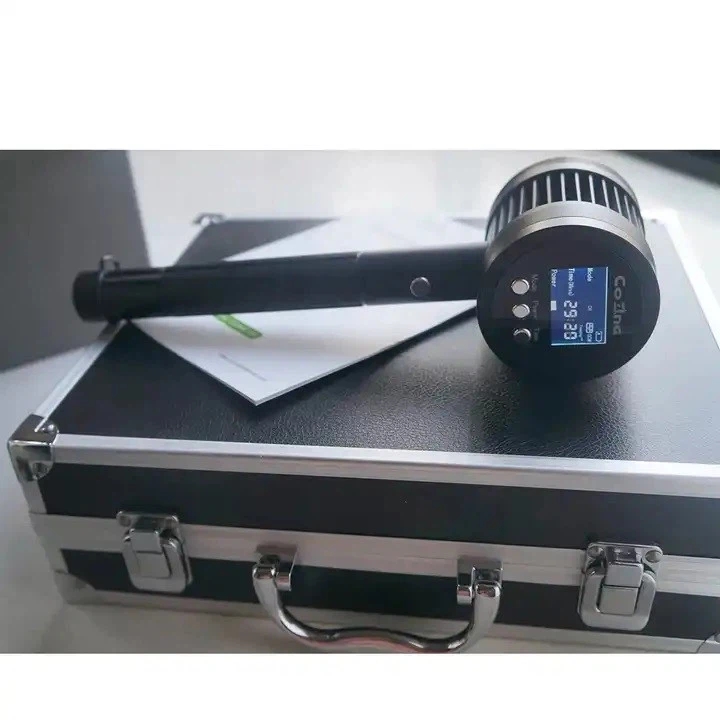

What's the indications of thecold laser treatment for arthritis?
- Osteoarthritis and degenerative processes
- Bursitis, synovitis, capsulitis, tennis elbow, impingement syndrome
- Tendonitis and tenosynovitis
- Oedema and distortion traumas
- Post-trauma pathologies, also due to over-exertion
- Addctors syndromes, tibio-tarsal sprains, insertional inflammations, patellar chondropathies, patellar chondropathies, and all sport traumatology

What's the technical parameter of the cold laser treatment for arthritis?
|
Model |
Wavelength |
Max. Output |
|
COZING-T05 |
808nm+650nm |
1200mw |
|
COZING-T05-1 |
808nm+650nm |
2W |
|
COZING-T05-2 |
808nm+650nm |
3W |
|
COZING-T05-3 |
808nm+650nm |
4W |
|
COZING-T05-4 |
808nm+650nm |
5W |
|
COZING-T05-5 |
808nm+650nm |
6W |
|
COZING-T05 (Rental) |
808nm+650nm |
1200mW |
|
COZING-T05P1 |
650nm+904nm |
25W |
|
COZING-T05P2 |
650nm+904nm |
75W |
|
COZING-T05-6 |
808nm+650nm |
7W |
|
COZING-T05-8 |
808nm+650nm |
9W |
|
Customized |
830nm/904nm/650nm/450nm/660nm/808nm |
100mw-75w as the customiz |
|
COZING-T05 Technical Parameters |
|
|
Battery Capacity: |
Built-in lithium battery 5200mAh |
|
Terminal Laser output: |
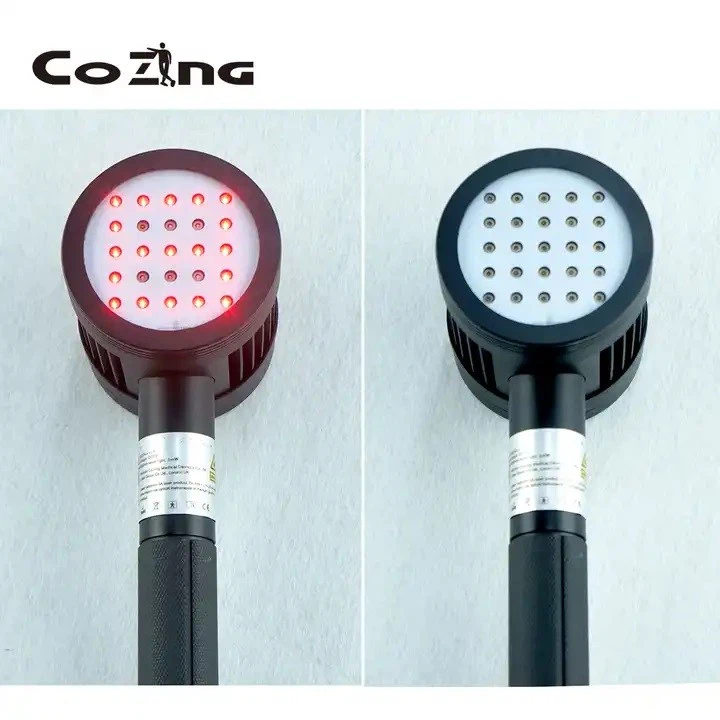
6 laser beams with 808nm,19 laser beams with 650nm |
|
Voltage: |
110-240V,50-60 Hz |
|
Working Mode: |
Pulse mode and continuous mode |
|
Time Setting: |
Start from 1 minute,1-60 minutes,adjustable |
|
Adapter: |
Europe America standard |
|
The Max. |
output:1295mW |
|
Display: |
Gray LCD display |
Background:
In essence, a laser is a simple device, the theoretical basis of which was established by 1920. The delay in construction of the first operational laser until 1960 probably resulted from theoretical possibilities exceeding technologic capabilities. The first laser used an optically "pumped" (activated) ruby rod and could produce only a red light. Today, however, these devices can produce both fixed and variable frequencies at different wavelengths and virtually any power.
The transparency of biologic systems, as well as the structures and pigments within them, varies widely with the wavelength of incident irradiation. Thus, carbon dioxide laser irradiation (10.6 /μm) is rapidly absorbed in water, and this laser is widely used in surgical procedures because of its limited penetration. The argon laser produces irradiation (0.488 to 0.545 μm) that is rapidly absorbed by hemoglobin. This laser is frequently used in dermatology and ophthalmology.
In the United States, low-energy laser treatments usually consist of exposures of about 60 seconds and powers of approximately 1 mW. These energies do not produce appreciable changes in the temperatures of the tissues being treated.5, 11, 15 Thus, any efficacy must be derived from a nonthermal mechanism based on interaction with, or absorption in, specific tissue substructures rather than the generalized heating of a tissue as a whole. Furthermore, if laser irradiation is postulated to be more effective than other light sources of the same frequency and intensity, this effectiveness should result from properties unique to lasers-that is, minimal beam divergence, coherence (wavelengths in phase), and monochromaticity (single wavelength). In practice, fiber-optics are often used to deliver laser irradiation to the treatment sites. These systems may diverge the beam at the fiber-air or fiber-tissue interfaces. Thus, the "narrow beam" capabilities of lasers are often not available, and only the characteristics of coherence and monochromaticity can contribute to the biologic effects. Although high-beam intensities and pure polarizations are produced by other sources, lasers produce beams that are more intense and polarized than are normally available.
In Europe, somewhat higher laser powers are frequently used (for example, 10 to 70 mW). At these energies, temperature changes of as much as 0.3 to 0.62°C have been reported.28 These changes, however, are minimal inasmuch as the conventional heating modalities of hot packs, ultrasound, and shortwave diathermy can produce changes of 5°C
What is the advantages of the COZING-T05P?
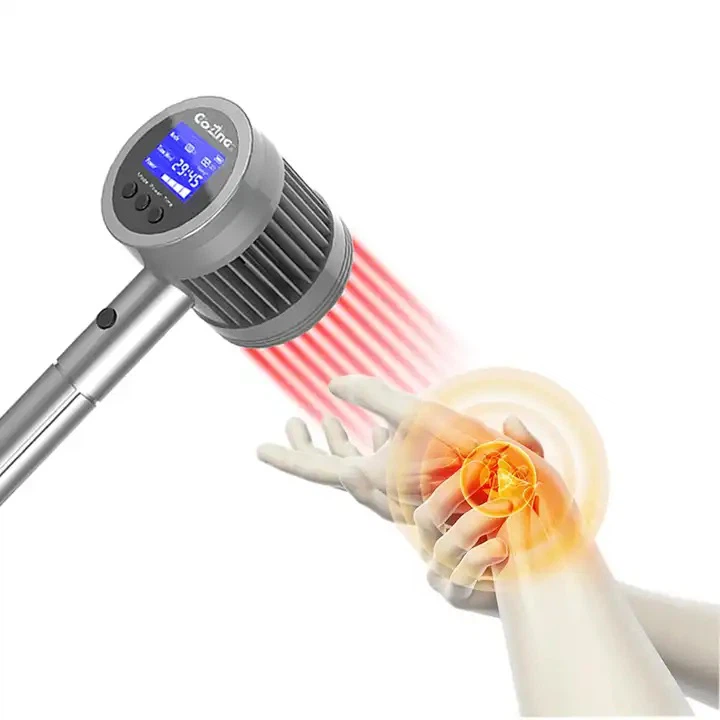
①Innovative Spherical Lens
②Feel comfortable in your body
③Homogenize the light
④Easy to use
⑤Handheld Equipment
⑥Easy operation
⑦Easy to Carry
⑧Long Battery Life
⑨A built-in rechargeable 3400mah lithium
⑩ LED Screen
⑪The digital display of treatment time, power, battery capacity, and ⑫working mode can be clearly seen
⑬Continuous Mode + Pulse Mode
⑭Mild release of energy along with instantaneous release of stronger energy, penetrate deep muscles, relieve nerves and blood vessels

what is cold laser treatment for arthritis working Principle?
650 nm laser can penetrate the skin to 2 ~ 3cm to relieve superficial pain and promote wound healing.
808 nm laser can penetrate deep tissues of human body to 5 ~ 6cm to treat arthritis and shoulder pain.
Perfectly combine medical 4PCS 808nm laser diode with the home 12PCS 650nm laser diode so as to treat acute and chronic pain effectively.
①Improving Blood Circulation
PowerCure Pro laser is used to directly illuminate the lesions, making the oxygen of tissue sufficient and increasing oxyhaemoglobin, which helps various tissues to repair the cell metabolism and maturation and thus accelerates the healing of the injured tissue.
②Diminishing Inflammation Quickly
Laser irradiates the lesion area to enhance the activity of phagocyte and improve immunity and inflammation quickly.
③Relieving Pain
The injured part could release the substance similar with morphine after laser irradiation. Laser irradiation could also reduce the conduction rate, power and impulse frequency to relieve the pain quickly.
④Accelerating tissue repair
Compared with healthy cells, damaged cells are easier to accept and absorb photon energy and they need additional energy to repair themselves. Therefore, the way of stimulating the cytochrome oxidase and utilizing the oxygen in the respiratory chain can help cells produce more ATPs in the mitochondria, thereby accelerating the stimulation of cell reproduction, growth and repair.

Product Display:

FAQ