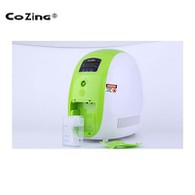
What are the indications of 8 liter portable oxygen concentrator?
- Help you by decreasing your shortness of breath or breathlessness.
- Circulate more oxygen I to your bloodstream which can improve your energy levels.
- Using oxygen therapy at night allows your body to get more oxygen into the blood stream so that you may get a better night's sleep.
- Help you become more active and get you back doing the activities you enjoy.
What's the technical parameter of the the COZING-OX01 8 liter portable oxygen concentrator?
|
Name |
best portable oxygen units Machine for Home Use, Continuous and Stable Oxygen |
|
Model Name |
Cozing-OX01 |
|
Power |
110W |
|
G.W |
6.5kg |
|
Oxygen flow rate |
1-5L/Min can be adjusted |
|
Oxygen concent |
>94% (under 1L oxygen flow rate) |
|
Noise |
≤45dB |
|
Dimension |
358mm(L)*321mm(W)*231mm(H) |
|
Oxygen density |
> 90% |
|
Atmospheric pressure |
50kPa-106kPa |
|
Oxygen purity |
Range from 30%-90% |
|
Voltage/Frequency |
220V±22V, 50Hz±Hz, 110V, 60Hz |
What are the advantages of 8 liter portable oxygen concentrator?
1.COZING-OX01 is a best portable oxygen units that can adjust the oxygen flow rate arbitrarily.
2.Lightweight,easy to carry.
3.Equipped with purification function, Intended to provide supplemental oxygen for people in their home environment.
3.The sound is below 45 decibel, Low noise design, relatively small in size and weight, oxygen 4.Concentrator suitable for the elderly, white-collar workers, pregnant, and students. Can be used at night.
5.Continuous and stable production of oxygen, and can also be used during sleep.
6.Equipped with chargeable battery and charger, suitable for traveling and household use.


How does the COZING-OX01 8 liter portable oxygen concentrator for work?
The atmospheric air that most people breathe every day is about 20% oxygen. The rest is nitrogen, along with tiny amounts of other gases. Oxygen concentrators take in atmospheric air, remove the nitrogen and collect pure oxygen for you to breathe.
First, it sucks in the atmospheric air through an air filter and forces it through an air compressor. The compressor pressurizes the air - think of it like blowing air into a balloon. As the pressure increases, the air travels into special filters. Oxygen molecules are smaller than nitrogen molecules, so the filters trap the nitrogen and let the oxygen pass through into a collection tank. The oxygen then travels to an oxygen outlet and through nasal cannula.


COZING-OX01 8 liter portable oxygen concentrator Display:

COZING-OX01 8 liter portable oxygen concentrator Clinical study:
Introduction
Portable oxygen concentrators (POCs) are essential medical devices designed to provide supplemental oxygen to individuals requiring long-term oxygen therapy. However, there is limited information on how patients use the mobility features and flow setting options of their POCs on a daily basis.
Methods
A retrospective study was carried out to evaluate POC usage among patients in the USA using the COZING-OX01 POC. The study aimed to (1) describe usage patterns of POCs, (2) examine their adherence to prescribed oxygen therapy settings, and (3) demonstrate the role of POC usage in achieving standardized long-term oxygen therapy (LTOT). Data were collected from devices returned for service or at the end of Medicare Durable Medical Equipment rental periods and streamed via a mobile app from 2018 to 2022. Metrics such as daily usage time, device disconnections, adherence to prescribed pulse settings, breaths per minute, power sources, and mobility while using the POC were analyzed. Additionally, device alert histories were reviewed.
Results
The analysis showed an average daily usage of 4.29 ± 3.23 hours, with a range from 0.35 to 15.52 hours per day. The prescribed pulse delivery setting was maintained by 31.34% of patients for at least 80% of their usage time. Patients were mobile 41.99 ± 33.33% of the time when the POC was on battery power. Some patients used their POC close to or beyond the lifetime of the column/sieve bed, as indicated by device alerts. Repair alerts occurred at a rate of 1.63 events per 100 years of use, suggesting that device reliability did not significantly affect usage patterns.
Conclusion
Patients utilized their POCs both during mobility and at rest. A significant number of patients adjusted their POC settings throughout the day, suggesting a need for dynamic oxygen dose delivery tailored to daily activities and sleep. Follow-up is necessary to ensure timely replacement of POC columns and maintain effective therapy.
FAQ