


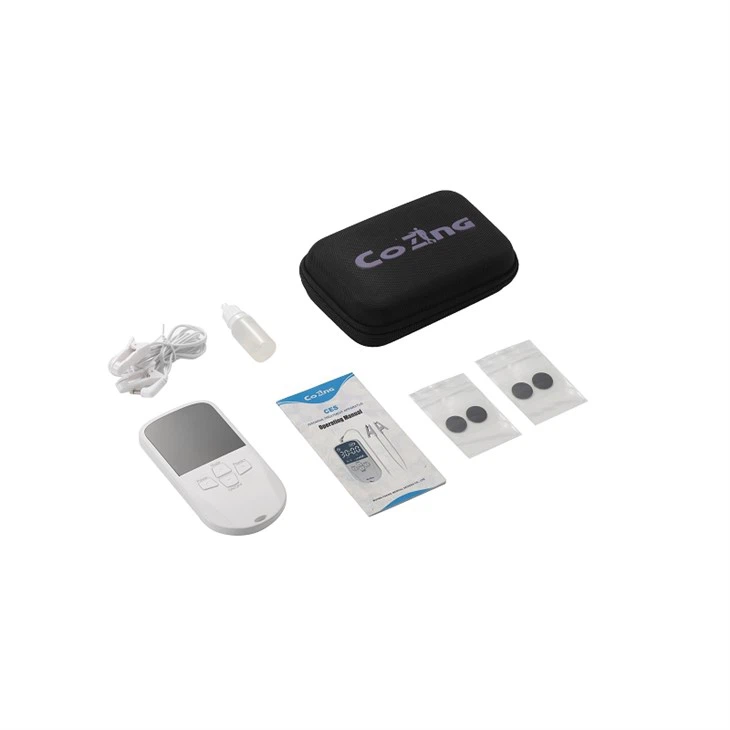


What are the indications of the COZING-IN01 home sleep remedies for insomnia?
- Feelings of worthlessness
- Loss of interest in activities and hobbies (including sex)
- Irritability or anxiety
- Long-term and unsubstantiated concerns
- Oversleeping or insomnia

What's the technical parameter of the COZING-IN01?
|
Pulse modulation firequency range: |
OHIz-15Hz |
|
Pulse diation time: |
100ms ± 10ms |
|
Single pulse width: |
2ms 土0.4mS |
|
Built-in lithiun battery voltage: |
3.7 -4.2V |
|
The cboice of stirmulus time: |
15 minutes |
|
Model name: |
COZING-IN01 |
What are the advantages of the COZING-IN01 home sleep remedies for insomnia ?
Cranial electrotherapy stimulation for depression,Oversleeping or insomnia
Approved by EMA for over-the-counter treatment.
LCD screen and easy to carry
This treatment method is approved by EMA for over-the-counter treatment.
Increases serotonin levels through gentle, pulsed alternating current

How does the COZING-IN01 home sleep remedies for insomnia work?
Cranial electrotherapy stimulation (CES) is a medical treatment that delivers a mild form of electrical stimulation to the brain for the treatment of depression and anxiety. More recent research indicates it might temporarily change the "connectivity" among certain brain cells.Research has found the electrical activity in your brain controls the neurochemicals regulating your moods, emotions, sleep and cognition.Stress causes that electrical activity to function improperly, causing hormones and neurotransmitters that regulate our emotions to become unbalanced.By indirectly stimulating brain tissue in the hypothalamic area, CES is thought to cause the brain to restore the various neuro-chemicals back to pre-stress balance.

COZING-IN01 treatment for insomnia Product Display:


COZING-IN01 home sleep remedies for insomnia Clinical study:
Objective:
The primary objective of this review was to comprehensively assess the efficacy of cranial electrostimulation (CES) in enhancing sleep quality.
Methods:
Our review encompassed a wide array of study designs, including randomized controlled trials (RCTs), crossover studies, quasi-experimental non-randomized controlled trials, and pre–post-single-group experimental designs. These studies investigated the impact of cranial electrostimulation on sleep, employing both objective and subjective parameters for assessment.
Result:
A meticulous screening process identified twenty-three pertinent articles, each subjected to thorough evaluation of their characteristics. Among these, six were classified as RCTs, which were subsequently subjected to methodological quality assessment using the 11-point PEDro scale. Notably, fifteen studies (including five RCTs) provided compelling evidence supporting the efficacy of CES in facilitating and enhancing sleep across diverse populations, as evidenced by both subjective and objective measures.
Conclusion:
Upon comprehensive scrutiny of the available literature, it is evident that cranial electrostimulation therapy yields positive outcomes in ameliorating various sleep parameters across diseased and healthy cohorts. Nonetheless, the need for additional studies to further substantiate the efficacy and viability of CES as a therapeutic modality for sleep-related issues remains imperative
FAQ


