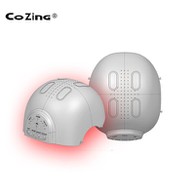
Indications
Photobiomodulation not only has direct neuroprotective effects on diseased or damaged neurons, but also influences the hypertrophy and proliferation of resident glial cells and inflammation
1. Alzheimer's disease
2.Parkinson's disease
3. Multiple sclerosis
4.Traumatic brain injury
5. Aging
6. gliosis and/or inflammation


Technical Parameters
|
Number of Diodes |
320 LEDs (ODM is acceptable) |
|
Wavelength: |
810nm LED [ODM is acceptable] |
|
Frequency Range: |
Adjustable from 1 to 20,000 Hz |
|
Default Frequency: |
30Hz (Frequency value not displayed; adjustable via control buttons) |
|
Treatment Duration: |
Adjustable from 0 to 30 minutes |
|
LED Intensity Levels: |
4 levels: 25%, 50%, 75%, or 100% |
|
Remote Control: |
Wireless remote controller included |
|
Total Max. output power : |
16W |
|
Single LED max. output power: |
50mW |
|
Operation Mode: |
Manual or remote control |
Principle
1.Photobiomodulation affects the overall large-scale networks of the brain. These large-scale networks involve the coordination and intercommunication of many different areas in cortical regions that are involved in processing and integrating information that is critical for the generation of many higher cognitive functions (e.g., perception, attention, memory, and emotion). One of these networks, the so-called default mode network, has recently been described as a cortical area that displays synchronized activity when an individual appears to be at rest and not engaged in any particular mental task. This network appears to be most active when the individual has internal thoughts, such as daydreaming, reminiscing, looking to the future, and wandering.
2.Although these cortical areas show higher levels of activity when the individual is at rest, activity in these areas decreases when the individual is engaged in a specific task, such as focusing on something in the external or internal (e.g., meditative) environment, or focusing on a given cognitive task. This "focusing" of the individual appears to deactivate the default mode network or parts of it, thus allowing various task-relevant networks to operate. Indeed, it is thought that individuals who are unable to deactivate this network while performing a task will perform the task poorly. The inability to deactivate the default mode network has also been reported in a variety of neurological disorders, including Alzheimer's disease; in these cases, it is thought that the ability to switch neural activity from the "default" mode to the "active and engaged" mode is impaired .
3.In terms of the effects of biomodulation, it appears to affect the functional connectivity of large-scale networks, particularly the default mode network. In healthy subjects, intracranial photobiomodulation reduced activation during a finger-tapping task and the strength of local resting connections in parts of the default-mode network. In patients with chronic stroke or Alzheimer's disease (both of which have abnormal network function), photobiomodulation strengthens and affects the functional connectivity of the default mode network itself, as well as its connectivity to other networks (e.g., the salience network and the central executive network). Essentially, in these impaired and/or diseased states, photobiomodulation may help to correct the imbalance in functional connectivity, restoring connectivity between cortical areas to "normal" levels. These improvements in functional connectivity are manifested as improvements in cognition and memory, for example, in patients with Alzheimer's disease.
Advantages
1.810nm NIR light penetrates 4cm to stimulate mitochondrial ATP production, reduce neuroinflammation, and promote dopamine receptor activity .
2.12-zone precision: Targets Parkinson's-related brain regions (e.g., substantia nigra) for symptom-specific protocols.
3.Market-Ready Packaging:Includes multilingual manuals, CE/FDA documentation, and customizable retail-ready boxes.
4.Boost cellular energy: Enhances ATP synthesis in neurons via cytochrome c oxidase activation.
5.Reduce oxidative stress: Lowers reactive oxygen species (ROS) linked to Parkinson's progression.
6.Stimulate neuroplasticity: Promotes synaptic repair and dopamine pathway regulation.
7.Non-thermal modulation: Safe, pain-free stimulation with no side effects.
Hot Tags: infrared helmet for alzheimer, China infrared helmet for alzheimer manufacturers, suppliers, factory, laser photobiomodulation therapy, photo bio modulation therapy, photobiomodulation brain, light therapy for brain, red light therapy device for brain, brain light therapy device