Indications
Neurodegenerative diseases
Mental Illness
Traumatic injury


Advantages
1.High-Density LED Array for Optimal Coverage
Features 320 high-purity 810nm near-infrared LEDs, scientifically arranged to ensure uniform light distribution and enhanced neurorestorative effects.
2.Clinically Optimized Wavelength (810nm)
810nm near-infrared light offers superior tissue penetration, reaching deep brain regions to stimulate cellular energy metabolism and alleviate Parkinson's symptoms.
3.Adjustable Frequency (1-20,000Hz) for Personalized Therapy
Wide frequency range (1-20,000Hz), with a default 30Hz setting for general use, allows customization based on individual needs for improved therapeutic outcomes.
4.Four Intensity Levels (25%-100%)
Adjustable light intensity (25%, 50%, 75%, 100%) accommodates varying user sensitivity, ensuring gentle yet effective treatment.
5.Dual Control (Manual + Wireless Remote)
Built-in buttons + wireless remote control for easy operation, ideal for users with limited mobility.
6.Safe & Energy-Efficient (16W Max Power)
Each LED operates at a safe 50mW max power, with 16W total output, balancing high efficiency with minimal heat generation for prolonged use.
7.Customizable Treatment Duration (0-30 mins)
Programmable timer prevents overuse, with auto-shutoff for convenience and safety.
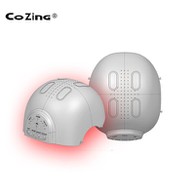
What's the technical parameter of the COZING-C320 infrared light therapy helmet?
|
Number of diodes: |
320 LEDs [ODM is acceptable] |
|
Wavelength: |
810nm LED [ODM is acceptable] |
|
Frequency: |
1-20,000 Hz can be adjusted |
|
The default frequency setting: |
30Hz--The frequency data is not displayed, but there are buttons available to adjust it. |
|
Duration: |
0-30 minutes adjustable |
|
The intensity of the LED: |
25, 50, 75, or 100% can be adjusted, which means 4 levels can be adjusted |
|
Remote controller: |
wireless remote controller |
|
Total Max. output power : |
16W |
|
Single LED max. output power: |
50mW |
|
Operation: |
It can be controlled manually or by a remote controller |
How does COZING-C320 infrared light therapy helmet work?
Red/NIR light stimulates mitochondrial respiratory chain complex IV (cytochrome c oxidase) and increases ATP synthesis. In addition, light absorption by ion channels leads to Ca2+ release, which activates transcription factors and gene expression. Brain PBM therapy enhances neuronal metabolism and stimulates anti-inflammatory, anti-apoptotic and antioxidant responses, as well as neurogenesis and synaptogenesis.
Function
CPZING-C320 810nm The light emitted by the device penetrates at least as far as the cerebral cortex to a depth of approximately 4to 6 millimeters below the surface of the skull Intracranial photobiomodulation in normal, healthy humans, both young and old, can improve higher cognitive functions, including reaction time or performance on a range of learning and memory retrieval tasks.
Clinical study:
1.The treatment of acute stroke is discussed in a two-part clinical trial series called the Neurological Efficacy and Safety Trial (NEST-1, NEST-2), which used an 808 nm laser on the shaved heads of ischemic stroke patients over a 24-hour period.
2.The first study, NEST-1, recruited 120 patients between the ages of 40 and 85 years who were diagnosed with ischemic stroke involving measurable neurological deficits.
The purpose of the first clinical trial was to demonstrate the safety and efficacy of laser treatment of stroke within 24 hours. Application of tPBM to the entire head surface (20 points in a 10/20 EEG system) approximately 18 hours after stroke, with or without stroke, significantly improved the prognosis of human stroke patients. After only one laser treatment, there was a significant improvement in the Real-treated group after 5 days, but not in the Sham-treated group (p < 0.05, NIH Stroke Severity Scale). This significant improvement persisted 90 days after the stroke, with 70 percent of the patients treated with Real-LLLT achieving a successful outcome compared to 51 percent of the control group treated with Sham.
3.The second clinical trial, NEST-2, enrolled 660 patients between the ages of 40 and 90 who were randomly assigned to one of two groups (331 treated with LLLT and 327 treated with Sham). Beneficial results were obtained in moderate and moderately severe (but not severe) stroke patients who received the Real laser treatment program. These results suggest that the overall severity of an individual's stroke should be considered in future studies, and that very severe patients are unlikely to recover with any type of treatment.NEST-1 was considered successful, although as a phase 1 trial it was not designed to demonstrate efficacy.NEST-2 was partially successful after stratifying patients to exclude very severe stroke or deep brain stroke .
Hot Tags: infrared light therapy helmet, China infrared light therapy helmet manufacturers, suppliers, factory, laser photobiomodulation therapy, brain light therapy device, photo bio modulation therapy, light therapy for brain, red light therapy device for brain, photobiomodulation brain