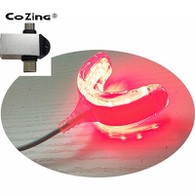
What are the indications of the COZING-USBO3 dental red light therapy?
- Cold Laser Red Light Therapy can be effectively used for the following indications:
- Dentin hypersensitivity
- Gingival inflammation and gum disease
- Oral soft tissue wounds and ulcers
- Surgical recovery after dental procedures
- Relief from toothache and discomfort
- Reduction of inflammation and swelling

What's the technical parameter of the COZING-USBO3 dental red light therapy?
|
Material: |
Food Grade TPE |
|
Wavelength: |
625nm ± 20nm |
|
Max. Output power: |
3200mW |
|
Diode: |
LED |
|
Jack: |
4- in -1 |
How does the COZING-USBO3 dental red light therapy work?
The COZING-USBO3 delivers the exact light wavelengths which penetrate deep into the gums tissues, sending healing energy to injured cells. With more energy, injured cells can function more efficiently, rejuvenate themselves, and repair damage. Imagine this healing light increasing blood circulation, further promoting the healing process, while cleaning bad bacteria and gently whitening your teeth.
As we all know, the mitochondria is the powerhouse of our cells: it makes them rejuvenate and produce more healthy cells.A cell which is injured won't be able to use mitochondria to repair itself and duplicate into new young and healthy cells.Red and Infrared Light Therapy sends energy to our cells, including the injured ones.With that additional energy they receive, these injured cells are able activate the mitochondria that was stopped.Injured cells can finally produce new healthy cells. The injury is repaired from within by your own body.

What are the advantages of the COZING-USBO3 dental red light therapy?
1. Non-invasive Treatment
2. It can connect to the mobile (3 jack as the options)
3. Enhanced Healing
4. Safe and Gentle
5. Convenient At-home Use
6.Easy to carry
7.Compact


COZING-USBO3 dental red light therapy product display:

COZING-USBO3 Dental red light therapy Clinical study:
RLT has been utilized as a supplementary measure during dental hygiene sessions for addressing chronic gingivitis in children, aiming to enhance results. Moreover, it has been applied in conjunction with scaling and root planing as opposed to the latter alone for treating severe periodontitis. The experimental group undergoing light therapy exhibited superior clinical outcomes in contrast to the control group. Comparable investigations employing light therapy alongside scaling and root planing consistently reported enhanced results in managing patients with chronic periodontal disease.
The consensus among numerous studies indicates that the efficacy of light therapy in improving outcomes primarily stems from its ability to reduce bacterial load and inflammatory markers when compared to traditional non-light-based interventions. Additionally, light therapy has been leveraged to accelerate the regeneration of both hard and soft tissues in extraction sockets and periodontal defects.
Endodontic Care
Due to its notable antibacterial properties, light therapy has been harnessed to enhance outcomes as an adjunct during root canal therapy. Furthermore, it has demonstrated effectiveness in alleviating pain associated with root canal procedures and retreatment therapies. Comparative studies between light therapy and conventional endodontic interventions for pulpotomy suggest similar effectiveness. Overall, the evidence supports the notion that light therapy can serve as a beneficial adjunct and potentially as an alternative for vital pulp therapy and treatment of primary teeth in humans.