


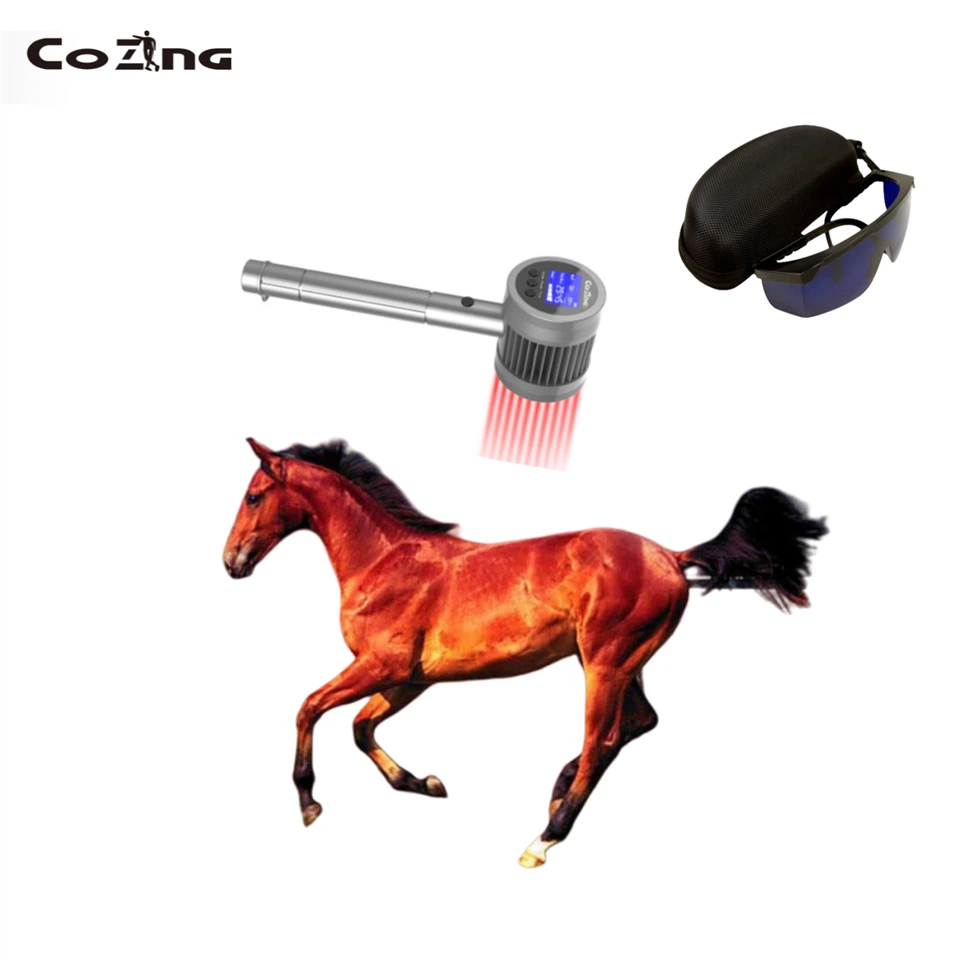
What`s the indications of the COZING-T05V best home laser therapy for dogs?
Stifle Injuries & Osteoarthritis
Hock Injuries
Synovitis & Tenosynovitis
DJD(Carpus)
Navicular Disease
Sinustis Rhinitis
Wound Healing
Gingivitis Stomatitis
Cystitis


Laser Assisted Rehabilitation for Dogs
1.The principles of dog rehabilitation are very similar to human rehabilitation. Veterinarians can use laser therapy to implement a rehabilitation program that restores mobility, builds muscle and joint strength, and helps dogs heal faster after surgery while focusing on pain relief.
2.Laser therapy can be initiated preoperatively, after an injury, or at the time of limb deformity referral. However, the most effective approach is to integrate and coordinate a laser therapy program from the initial injury through surgery. Laser maintenance therapy can also be used after rehabilitation to help dogs continue to maintain mobility, strength and fitness.
What's the technical parameter of best home laser therapy for dogs ?
|
Model |
COZING-T05V |
|
Laser Type |
Class 4 Semiconductor Diodes |
|
Wavelengths |
808nm (6 diodes) + 650nm (19 diodes), the wavelength can be selected |
|
Power |
250mW (808nm), 5mW (650nm) per diode |
|
Total Output |
1295mW (±20%) |
|
Battery |
5200mAh lithium can be charged and repeat usage |
|
Modes |
Continuous/Pulse |
|
Applicability |
For Pets and Humans |
|
Frequency |
1-9999Hz can be adjusted |
Advantages of laser therapy device
1. Wide range of applications, both for humans and animals.
2. Laser wavelength 808nm, 650nm can be selected for treatment.
3. Effective treatment, each treatment takes only 3-10 minutes; after the first treatment, 30%-50% of the pain can be relieved.
4. CW and Pulse modes of operation
5. Long service life, more than 10,000 hours
6. High return on investment, no consumables for life.
COZING-T05 Clinical studies
Background:
Osteoarthritis (OA) is common in dogs, causes chronic pain that affects quality of life, and may not respond to pain medications.
Objective:
The purpose of this study was to determine whether low-intensity laser therapy (LLLT) can improve quality of life and help reduce the use of systemic analgesics in dogs with OA.
Methods:
Seventeen dogs diagnosed with osteoarthritis (OA) with pain were included.The diagnosis of OA was confirmed by orthopedic and radiologic imaging. Pain was assessed in each dog using the Canine Brief Pain Inventory (CBPI) developed by the owner, the Visual Analog Scale (VAS) used by clinicians, and the Colorado Canine Chronic Pain Scale. Each study dog received low-intensity laser therapy (LLLT) once a week for a total of 6 weeks. The CBPI was repeated at weeks 2, 4, 6, and 8 after the first laser treatment, and the VAS was reassessed at weeks 2 and 6. Dogs were observed for laser-related side effects.
Results:
Both CBPI and VAS were significantly lower (9.2 ± 3.8 and 5.2 ± 1.1, respectively) after the first laser treatment compared to pre-treatment (11.8 ± 3.6 and 7.6 ± 0.9, respectively; p = 0.018 and p < 0.001) and continued to decrease until the end of treatment. Based on these results and the functional improvement assessed by the orthopedic surgeon, the clinician reduced pharmacologic analgesic therapy in 13 of 17 dogs at week 2. No laser-related side effects were observed.
Conclusion:
This retrospective report lays the groundwork for future studies aimed at clarifying whether laser therapy is helpful in treating pain associated with canine osteoarthritis. Preliminary findings are encouraging and suggest that low-intensity laser therapy (LLLT) may help reduce the use of analgesic medications and improve patient satisfaction and quality of life in dogs with osteoarthritis.
Hot Tags: best home laser therapy for dogs, China best home laser therapy for dogs manufacturers, suppliers, factory, equine laser therapy, 40hz light therapy, equine cold laser therapy, laser treatment for canine arthritis, laser treatment for arthritis in dogs, at home laser therapy for dogs


